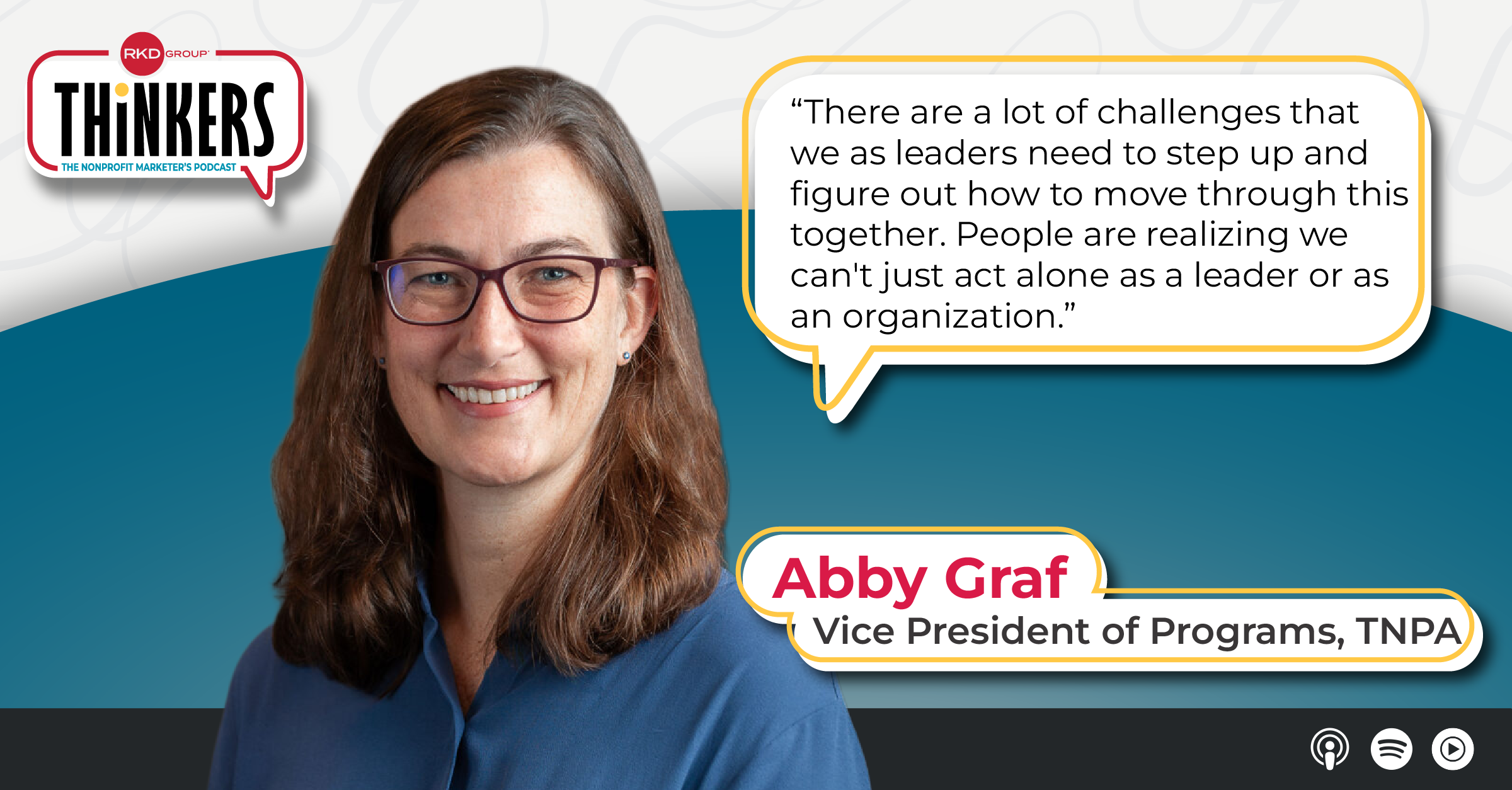
Abby Graf, vice president of programs at the Nonprofit Alliance (TNPA), is one of the most thoughtful leadership facilitators in the sector. On this episode of the RKD Group: Thinkers podcast, Abby shares how a lifelong pattern of bringing people together, from organizing Earth Day as a teenager to guiding leadership labs for nonprofit executives, has shaped her approach to helping leaders navigate change with clarity, courage and community.
Abby’s path to “dream job” status didn’t come from chasing a job title. It came from noticing what makes groups work, asking better questions and creating the conditions where leaders can learn from one another. In her world, leadership isn’t a solo act. It’s a shared practice that happens at the me, we and community level.
Today, Abby leads TNPA’s program work, focused on developing nonprofit leaders across the sector, supporting individuals, teams and organizations as they build practical skills, strengthen decision-making and respond to the realities of a shifting landscape. Whether the topic is budgets, AI, risk aversion or big-picture threats to the sector, Abby’s goal is consistent: help leaders step back from the urgent and make space for what matters most.
What stands out about Abby is her ability to pair strategic thinking with real humanity, encouraging leaders to experiment responsibly, stay grounded in mission and keep moving even when the path forward feels uncertain.
In this conversation, Abby reflects on the experiences that shaped her leadership lens, how creativity strengthens leaders, why nonprofits struggle with risk and what she’s hearing from leaders as 2025 wraps up.
She shares:
- Why facilitating leadership growth feels like a “dream job”
- How the "me, we, community" framework helps leaders lead at every level
- Why creativity isn’t optional for leaders and how it builds resilience
- How nonprofits can think about experimentation in a risk-averse sector
- What leaders are grappling with as the sector faces disruption and uncertainty
Show Chapters
- 00:04 – Episode intro (and distracted season energy)
- 05:09 – Abby’s dream job: curiosity, connection and guiding conversations
- 07:05 – High school leadership roots + noticing how groups function
- 12:21 – Puppetry, nonprofits and building the “business layer”
- 17:52 – Nonprofit risk aversion: donors, budgets and fear of failure
- 24:19 – 2025 wrap-up: sector-wide challenges, AI, budgets and generosity
- 28:22 – Barriers to action: risk, laying low and waiting for someone else to leap
- 33:52 – Closing thoughts: keep moving (and maybe play a board game)
Meet our guest
Transcript
Justin McCord (00:04.94)
Welcome to the RKD Group Thinkers podcast. I'm your host, Justin McCord, and with me is Ronnie Richard. And Ronnie, I'm easily distracted today.
It's pretty clear, yeah. mean, our listeners are going to find out in a second that we started, we hit go and you were physically there, I guess.
Yeah, I don't know. My mind is not out of office for sure. I had just looked to the side, looked to the side at a couple of notes and things and then there was this awkward delay followed by me not being able to start without laughing. know, like I said, distracted today.
It's a good season to be distracted.
Is ADHD something that can happen like sporadically or is it all the time?
Ronnie Richard (01:06.382)
I don't know. I'm not a doctor. Sorry.
You're... Why have you been charging me hourly? Like office...
damn he just figured it out
All right, so our guest today is someone that plays a very unique role in our world. Tell us a little bit about Abby.
So yes, we have Abby Graf. She's vice president of programs at the nonprofit Alliance or TNPA as most people know her know it by. So Abby works very closely with a lot of different leaders across the nonprofit sector in a lot of different ways that she kind of unpacked in this episode that, you know, it's working on leadership. On a personal level leadership in a group and the people in your organization and then leadership sector wide.
Justin McCord (02:02.078)
three different levels of it. And Abby, to me, was a really fascinating conversation because I think maybe if ever there was a person who would fit the name thinkers the best, Abby, she's very introspective, but also very thoughtful in what she's putting out there. And obviously working closely with leaders, you know, has to be very thoughtful in that aspect too.
You're right. you know, whomever they is, has said that iron sharpens iron. so, you know, Abby from the Steel City, as it were, is a little bit of that force for us. And so I like that, I like the way that she approaches the facilitation of seminars and workshops of which I've been able to
participate over time and before we get to the conversation, we just want that if you are looking for opportunities to develop your own leadership skills, the Nonprofit Alliance and the work that Abby Steers is for my money, the best in the business. here without further delay is Abby Graf from the Nonprofit Alliance on the Arcade Group Thinkers podcast.
Wait, I didn't see that. I looked away. Did the countdown happen?
Uhhhh
Justin McCord (03:40.334)
This is it.
But this is that's what I get for, you know, not being attentive. Abby, here's I've been trying to think about like how to best start our conversation. And the thing that keeps coming back in my mind is that I see you as someone who shepherds so many leaders.
in our space and that I know that it's not all that you do, but that you are essential to teaching others to fish.
How do you think about that? Like, what does that kind of feel like? Is there weight associated with that? whoa. That's just, that's fascinating that that's the role that you play.
Yeah, that's a great question. You know, even as you were describing it, I'm like, yeah, that is my dream job. So to ask if there's like weight, like am I being, I don't think I'm being irresponsible. I think I carry that weight and I care about it a lot. But really for me, it's just like the pleasure and the joy and thinking about what are the biggest challenges people are facing right now, leaders are facing right now. What's the thing that I can help?
Abby Graf (05:08.974)
provide to them, if this is my job, which I would agree with you, it is, and that's the part that is my dream job. What are those biggest challenges? How can I be the one who steps back? Right? Like so many leaders have your day to day, your day job. And it's like, if only you could step back and read these 25 articles or figure out what the best practice on this is or strategize about that, how can I help move that?
conversation, that challenge, that grappling with whatever the issue is of the day. How can I help move that forward? So in a lot of ways for me, I don't feel stressed about it. I feel like it is an absolute honor to, you know, I was running our essential leadership lab last week and it's like, my gosh, I have such a like high after those. Like I love just being in that room with such smart people wrestling with
what we're talking about, thinking about how they're applying it or not applying it and learning from each other. Like, I just love that dynamic. I think part of it is my own curiosity and really approaching it with curiosity. And part of it is my own love of people and just wanting to talk to people and not, and I don't have to always have the answers myself. So I think like that helps relieve a lot of the pressure.
You get to ask the questions, right?
Exactly. I I try to help guide a little bit too, but you know, if we can either find an answer together, but you know, when you're working with the leaders in our sector, in our nonprofit world, people are smart, people are strategic, people are trying to think about these things. So there's so much expertise in every room that we walk into that if we can just help people connect around that and make new expertise together.
Abby Graf (07:05.28)
then that's the, that's like, it's like the, haven't thought about it this way, but it is like the sparks that are going to generate all the energy and keep us powering forward. So I love that. That's my dream job and love doing it.
When did you realize that it was your dream job?
All right, so that is kind of funny. And this was cross my mind the other day. So when I was in high school, I'm literally gonna go back to high school. Let's go back. Remember those great years being 16, 17, 18? You know, I was the one who was student council president and I did have, I don't know, whatever leadership, right?
Let's go, let's do it.
Abby Graf (07:48.588)
And I remember there, you know, in high school you get recognized for like, here's a scholarship on leadership that you're going to apply for and get to go to college. But I really remember having this moment of like, leadership isn't a career. Like you have to figure out what you're doing with leadership. And I do think that's true. And somehow I have turned that into a career. So.
think that's it. I think it goes back to high school. I just loved, okay, so another high school moment. And again, leadership. I was in high school in 1990, and it was the 20th anniversary of Earth Day, and I was growing up in Pittsburgh, and I was gonna volunteer. I cared about the environment, and I started going to these meetings, and I ultimately, I don't even remember what I did, but I organized.
the entire children's section of Pittsburgh's Earth Day in 1990 as like a 17 or 18 year old. Like, why not? Somebody needs to do it. I might as well do it. So I would go to these meetings and I remember coming back and saying to my dad, oh my gosh, in our student council meetings, we have to fit them into a 38 minute period of class, like a class period. We get so much done in 38 minutes. And I'm going to these evening meetings with all these community volunteers and it's like,
Everybody's talking and we spend three hours and still don't even get as much done. So I think it's always been something I've always paid attention to.
I love that. I really love that. And I love that you know that about yourself and that you can already that you can tie back like these incidents and moments, forks in the road, little instances and anecdotes that now have shaped how you show up and how you approach the work that you do and all of the dots in between.
Ronnie Richard (09:46.126)
also noticed, you clearly have the thread we were talking about of bringing people together. There's also a touch of some artistic, little bit of arts in your career. Puppet show place theater, for example, arts, go on us, is that how you say it? How did that come into play? How did you start going down that avenue?
Yes, yep.
Abby Graf (10:14.488)
we're gonna go back to high school. I always loved art. When I was kid, I made art. I took in the hallway through high school. I loved art. I used to call it my sanity class because I was also a smart kid. So I always had like, my career wasn't gonna be art. I had all my academics. I had all these things going on. And smart and academic aren't always equal, but I was also the academic. Or doesn't always go together.
So art, I called all the way through high school my sanity class. Even in college, I tried to keep something. And I think I did, almost every semester, either have a dance class, a photography class. I gave up drawing and painting. Then I actually went back to art school in my 30s. So I already had a BA, and I went back. So art has been really important for me. And this actually just came up in our leadership lab last week that I went to art school because I, in fact, can draw.
things if you want me to. But if we were just doing it in a five minute exercise, mine would just look as stick figure or as comical as the next person's. But if you gave me an hour, hour and a half, I could make something either realistic or abstract or whatever you wanted. So love art. Where does that come from? Okay, that's a little bit of an aside to just say, I think art's really important. The thread for me,
It is bringing people together, but it's making people's voices heard. It's helping people feel the agency and the responsibility to make their voices heard to create the world we want to live in. So that's really the thread for me that is always super motivating. And I think art is a really important and different way of not just making people's voices heard, but also helping the non-artists get in touch with what they're thinking.
So I still see art as part of this civic conversation of what we're doing. So.
Abby Graf (12:21.612)
I will tell you, so the Puppet Showplace Theater was the first time I brought those two, my two career path, kind of my nonprofit career path with my art career path, because I'd always kind had them separate. I'm going to be one, and then that art thing is going to be my hobby. And I loved it. And I will tell you, if you know anybody who's a puppeteer's heart of gold, I'm going to say every single one. We're just going to stereotype it right now. If somebody has committed their career to puppetry,
They're creative, they're out of the box, they're not looking to make money, even though Jim Henson might have. Like they are realistically not looking to make money, they just have something to say and they're saying it. It was so much fun. And it totally played into my like more academic aspect of running nonprofits because that organization was 30 years old and was on the brink of closing. The founder had passed away, the funders were all leaving, they were.
bottom was falling out and I got to come in and just say, listen, we're going to shore up. We're going to get our basics back in a row. Basics consolidated. And it was just this really fun strategic project to be able to come in and help these puppeteers with hearts of gold put a little business layer on top of what they were doing. So for me, it doesn't feel so different. Arts Gowanus, again, just this fabulous opportunity. I will say Gowanus is a neighborhood in Brooklyn that used to be industrial.
and in fact used to be a swamp. Huge American history. Buffs should know. Lots of revolutionary battles happened. If you've watched Hamilton and they actually talk about, they don't say the word goannas.
Then it became a canal and that with lots of industry around it. then, you know, manufacturing started to leave New York City. So I never am leaving the politics of it. Then it's becoming gentrified. And what it has become in the past five or 10 years full of luxury apartment buildings is something totally different. So even when I'm running an organization that is mission is around the arts, I'm looking at that community piece. I'm looking at that. What's the world that we want to be creating peace and what's our
Abby Graf (14:33.198)
voice in that. So that's a very long answer, but that's the thread for me. And that's where arts comes in and it might come in again at some point. I don't know, but.
I it's great though, because I mean, you think about art so much that artists can bring a lens to the change they want to see that sometimes we can't see ourselves.
And I think we do separate it out so much. And my sister, also very active in nonprofits and in social issues, we had this probably 20 years ago idea that we really should talk about art and activism, which there are people out there who talk about art and activism. And there's something just real, really theoretical. So I would even argue if you're painting a gorgeous vase of flowers or if you're painting as abstract, you're still in conversation with the world and in conversation with whoever's gonna look at that about what the world.
could be or should be, that it doesn't have to be a direct political statement to be part of that conversation. And I appreciate the direct political statements too.
Well, there's, but there's also like a, there's a tangent from that on like the role of a creative outlet in leadership, right? And, what, for an effective leader, what part does creativity play? Whether or not that manifests in, in, you know, painting or drawing or puppetry.
Abby Graf (15:58.638)
or just the other aspects of creativity. There's something there about, think leaders need to know, identify, and work some type of creative muscle, regardless of the role that they play in their organization.
love this idea. I haven't thought about it so much in the way we're thinking about it right now or the way I'm thinking about it in this conversation. I mean, there's a couple different levels, right? Like we should all have some outlet as leaders so that we get out of...
our comfort zone. Well, that's almost two different things. Like one is just as a personal, like, are you a runner? Go run. Are you, you know, what are the, are you a painter? Go paint. Like what is your outlet? And creativity can be part of that. But I'm also thinking about this other layer as leaders to put ourselves in situations where we're not comfortable, where we're not the expert, where we're not successful and be willing to be that humble. And a lot of times creativity is that even, even my
colleagues from art school who went on to become artists, they're pushing themselves out of their comfort zone constantly and trying things that get rejected or trying things that don't work. So I think there is something in that creativity lens of being willing to try new things and being willing to be failed, being willing to be wrong, which I think we do talk about in leadership, but how do you like really bring that into your heart? And I think there is something. So we're going to have to continue to develop this idea of art.
I am sensing that there may be some sort of either sketching or sculpting that happens at a future leadership summit. Absolutely.
Abby Graf (17:52.878)
Don't want to call out anybody, but my CEO might say that that's her worst nightmare. And we say that's what it's about. So, we know she'll be gay.
Yep, yep, exactly. Yes.
I want to touch on something really quick that you just said you were saying about stepping outside of your comfort zone and not being afraid to fail. In our industry and nonprofit sector, we often see this fear of failure because you're often working with tight budgets, for example, and this is money the donors have entrusted to us. We can't take that and try something that might fail. So there's this hesitancy in these leadership
meetings that you have with all these nonprofit leaders, how do you talk to them about this subject?
Yeah, I think it's a really great point, Ronnie. And I think in the nonprofit sector, we just have this structural aversion to risk and a structural aversion to failure. So it is an experimentation that fits in that, right? If we're going to experiment, we're taking a risk. And I do think that's a dilemma. And it is how can we be responsible to our donors?
Abby Graf (19:08.704)
Now, I do think there are some donors who are willing to support some of those risks. We've talked about that. We've talked about how as leaders can you be within that responsibility or your board is agreeing here's a chunk of money that is specifically to go outside of the comfort zone, is specifically to try new things. mean, past 10 years or more innovation, such a buzzword. So the fact that the business world is valuing it lets the nonprofit world start to say we need to do this.
We need to figure out new ways of doing things. So, I mean, think you the nail on the head and we haven't solved it yet. So when we do, I'll let you know. there, you know, we do need to be responsible to our donors and we do need to have, and there is a lot at stake in the nonprofit world, right? Like we want to achieve our missions. We want to have that impact. We want to have. So when something is known to be successful, it's really hard to tweak it or mess with it.
Although, see, we're gonna go back to volleyball. I mean, we're gonna go back to high school all the time where I did play volleyball. But my coach, shout out to Bob Miller in the North Hills of Pittsburgh in North Allegheny, which is different than the North Hills, if you want to talk high school rivalries. But he did take me aside and he said, you're playing at this level and that's great and we're happy with that. And what I'm trying to give you now is a different way of doing it.
and I know you're gonna get worse, you're gonna go down this hill and you're gonna get worse because you're trying to do it differently. And your whole instinct is gonna be to get back up to that higher level, that comfort, as soon as you can. And he's like, what I am asking you to do is push through that discomfort, push through that getting worse. And if you do, you'll come out on the other side at a more elevated playing level. And that has stuck with me.
I have used it, I have thought about it for myself, I've talked to other people about it. We were just talking about it with a couple leaders last week and I do think one of the things if you are a leader thinking about that is not only telling it but for me to hear that the coach knows I'm going to get worse before I get better and is expecting me to go through this dip is reassuring in that ability to get worse before you get better.
Justin McCord (21:25.752)
So how do we create that for our staff? How do we create that for our organizations to be able to get worse so that they can come out on the other side and be better?
God, what a great word from your coach, right? And something that's hung with you. Yeah. Besides Coach Miller and now in thinking about, you know, and even in just the last six to 10 years or, you know, zoom in even closer to since you joined TNPA in 2020 and since that time.
Who sows into you because you sow into so many people in the space. Who are the people that you look to for that guidance, that mentorship, that someone who is going to pull you aside now like Coach Miller did back then.
That's a great question. Get me out of high school. Get me into my adulthood. Okay.
Hey, it could be Coach Miller. Like you could be, you know, you could be in a slacker with him. Yeah.
Abby Graf (22:36.694)
Yeah. You know, I do feel like working with this amazing crew of leaders has been, you know, I said it's such an honor for me, but there are side conversations about what needs to happen. You know, and I do have to give Shannon McCracken a lot of credit. Like she is a great sounding board. We are, I think, a great team as far as playing off each other, bringing different strengths, pushing each other to figure out what.
what needs to happen and how to think about things. So I think that, I think my planning committee, my leadership steering committee at the Nonprofit Alliance is an amazing group of people. I get off of every one of those planning committee meetings like so inspired and so new ideas sparking from what was said and ideas that we had. So I feel like being surrounded by so many great leaders is really
helpful to me and buoys me and I feel really supported by that. And I can have sad conversations too. So I think that's my current, as well as my kids who just keep me honest.
It's good to have those as well.
I think it goes without saying a little bit, but I'm going to say it's been a year for nonprofits. It's been a year. You're coming off the central leadership lab you said last week. As you think about the year ahead, we're wrapping up 2025 here. What are the challenges that you were talking about? Maybe some of the ideas being discussed for solutions. What were the topics du jour?
Abby Graf (24:19.744)
Yeah, I mean, I think there's two different things that are coming to mind. And one is the essential leadership lab where we really are focused on three different levels of leadership, the individual. How are you? So what am I doing that impacts people? The team, your team, what are you doing as a team to impact people? And then really the nonprofit sector as a whole. What can we do? So we talked about it, our shorthand is me, we, community. I don't think we made that up, but it's helpful.
individual, the we, the people you actually meet in the community, the really broader sector. And it has been a year and it is a really, nonprofits are under threat right now. And so I think at that really big sector wide level, there are a lot of challenges that we as leaders need to step up to and figure out how to move through together, right? Think what has happened over the past
nine, 10 months is people realizing we can't just act alone as a leader, as an organization. We need to be in conversation with each other about what are we doing? What are you doing? What am I doing? How am I responding? How are budgets being impacted? How's your budget being impacted? How's your program being impacted? How's your ability to implement being impacted and have those conversations that kind of work together?
There's a lot of conversation about what the nonprofit sector will look like over the next 12 months, 24 months, five years, and how we're going to evolve to continue to have social impact and be the best version of ourselves that we can be.
I think that sector-wide context is really big and really top of everybody's minds right now. There's lots of other conversations around AI, which funny now, two years ago, we wouldn't have thought AI would be the little thing or the, I'm not going to say it's a little thing, but the second thing, but it is not.
Justin McCord (26:25.324)
And what does that mean for being a leader? And how do you use AI or help your staff use AI or accept or set limits around AI? Just this whole new thing, of course. lot of people talking about, how does that impact leadership, right? Is how then I try to think about it too. then, yeah, budgets. Budgets are big. Fundraising's big. How are we keeping people generous across the board?
So the same topics and just grappling at them at a leadership level, I think.
Abby, do you? I think the second and third thread that you you talked about the AI thread and the the budgets and fundraising thread, those tend to be now they're a little more persistent, right? They're a little more like baked into the ongoing discourse. The first thread that you talked about in terms of maybe some more existential things. Have you seen that?
Have you seen any barriers to productive leadership conversations over the course of the past year? Like, is there a general consensus from, you know, from the leaders that you interact with of the need to evolve, or is there resistance that manifests in one way or another?
Yeah, think it's a great question. You know, I think there is a discrepancy between as leaders how we're acting and when we're thinking about the me level and who I want to be and what I think is a good idea. And then if the we level becomes your organization, you instantly put on that. Even if I do, I think about me and then I think organizationally, you put on that more risk averse hat.
Abby Graf (28:22.336)
And then the sector as a whole sometimes gets people a little more open and creative again. So I have seen a lot of struggling with like, how much are we bringing on ourselves if we, know, how much do we just lay low below the radar screen and keep pushing forward and hope that everything stays or returns to the way it was working before? How much are we?
individually grappling, this is where I do see more openness to individually grapple with like what should the sector look like, what should we do with? And I think as organizations, we're just seeing that real risk aversion, kind of stay below the radar screen. How do we keep having the impact we need? Because as we know right now, a lot of the work of nonprofits is needed more than ever. If you're talking about food,
pantries, food support, social services, health support to people.
goes back to what we said earlier. mean, it's, it's a little bit of a afraid to fail. And at the organizational level, maybe we see it sector wide that this is what needs to happen, but maybe hoping somebody else takes the leap and I'll follow. Yeah, this is every and everyone's waiting for someone else to take the leap.
Yeah. You know, think, you know, to hit for me also just to be a little more direct because it's unusual for me not to be super direct, but this particular administration is disrupting a lot of sectors and the nonprofit sector is not excluded from that. individual organizations, I think, do not want to become the target of any attack.
Abby Graf (30:08.364)
and several individual organizations have been threatened or have received letters that they're going to be investigated. So how much, you know, we're gonna see this play out. How much do we need to defend our nonprofit sector? Now, I've been in lots of great conversations about what does that mean? What does the nonprofit sector mean? Is it our great big vision of social impact, which when I talk about like my...
part thread being, want people to have their voice and create the world we want to create. That's how I end up in the nonprofit sector because we are creating the world that we believe should be created. I know some people in the government sector would say they are doing the same thing. Like, I guess in the private sector, we're all together just trying to create the world that we want to have. So I have seen people talk about, though, nonprofits. What does that mean? Are we just defending our 501c3 status? Well, what does that do for us? That's a tax status.
Are we defending our right to have an impact on civic society? Are we protecting our right to actually help our fellow human beings and our neighbors? Like, what does it mean? And that is actually a pretty exciting thing that comes out of all this. What does it mean to us to be a nonprofit sector? You know, in years we've, for years we've talked about like, we don't want to define ourselves by what we're not, not profit. So are we the social impact sector? Are we the...
Lots of other ideas thrown out, but I've seen those conversations get really energized. And should we lose this 501c3 tax status? What is next? Because our missions don't disappear. They don't get solved. All it means is a donor can't get a tax deduction then. And we can't operate without paying taxes as nonprofits. So there are real implications. I'm not ready to throw it all away, throw away the 501c3.
The fact that people are kind of thinking beyond that and thinking like what's the either the big picture or the underlying foundation of what we're trying to do as a sector, I think is actually kind of exciting and could bring us out in a really positive space on the other side.
Abby Graf (32:13.518)
I mean, I think that's in my mind, there's two components to that as a response. On one hand, maybe no matter the circumstance, you're gonna see people fight, flight, freeze or fawn, right? On one side, like there's four responses that folks are gonna take in any given circumstance. And so, but then philosophically, what we want
to see for the sector is an acceptance of change as a reality because stagnant water breeds disease. Moving water is where it's at. Moving water brings vitality, brings life. And so we want to lean into being moving water and then still control where we want to go and what we're trying to accomplish. so...
You know, there are those things that are like two separate tensions that I think that we're living with in real time.
think that's just a great point. We need to be moving. So the other analogy, if anybody's a skier, a downhill skier, right? If you try and be perfectly in control, you're probably gonna get hurt, you're probably gonna fall. Where if you go a little bit and let go a little bit. So I'm just playing, then you can actually be more in control by letting go of control a little bit. So how do we play that over to...
apply to this moment and this context, but I think there is really something there.
Justin McCord (33:51.734)
I think that it's so special in our sector that we have organizations like TNPA and people like you doing the work that you're doing. And I think that a lot of times it becomes like normal course of business for us to see another conference, another professional development event, et cetera, et cetera. I don't know that...
in other sectors that we have the same attention to compassion stewardship and leadership stewardship in a way that draws the same impact out that we do here. And you're a big part of that. And so we thank you for the work that you're doing on that aspect for all of us and on all of us. So thank you for that and for spending some time with us today.
Yeah, thank you guys. It was fun to talk.
Now let's all go play a
Exactly. Wingspan, settlers of Catan.



Leave a comment: