
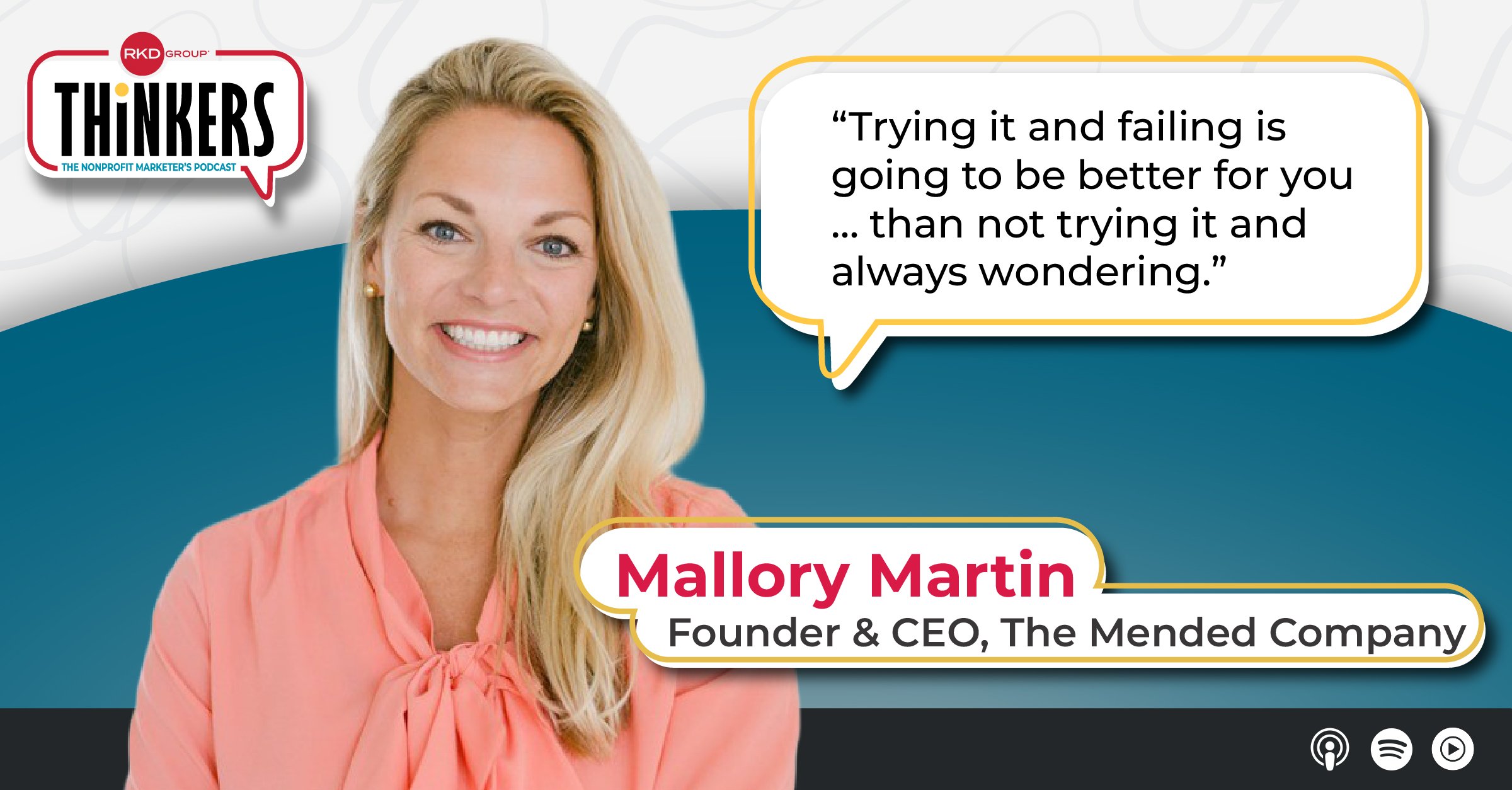
In this episode of “RKD Group: Thinkers,” we sit down with Mallory Martin, founder and CEO of Mended, a social impact business partnering with survivors of human trafficking to create hand block–printed textiles.
Mallory’s journey spans professional sports, international nonprofit fundraising and now entrepreneurship. What connects each chapter is purpose. From selling six-figure sponsorships for the Dallas Stars to fundraising for the International Justice Mission (IJM) and ultimately launching her own mission-driven brand, Mallory’s path reveals how nothing is wasted when calling and capability align.
Her story is one of tension and transformation: loving the for-profit business world while feeling drawn to humanitarian impact, navigating motherhood and career shifts, wrestling with the emotional weight of confronting modern-day slavery and eventually stepping away from stability to build something new.
Today, Mended employs 23 survivors of bonded-labor slavery in South India, who create hand block–printed tea towels, table linens and textiles. Each product carries a story of restoration.
What stands out most about Mallory is her clarity. She knows what she’s good at, what she’s not good at and why she’s building what she’s building.
In this conversation, Mallory reflects on the moments that shaped her and what it really takes to build a purpose-driven company from the ground up.
She shares:
- The emotional toll of fundraising around human trafficking and the mindset shift that made it sustainable
- What bonded-labor slavery looks like today and why economic opportunity is key to prevention
- What it was like pitching Mended live at the Clover by Shark Tank Summit
- The three personal checkpoints she uses to measure success as an entrepreneur
Show Chapters
-
00:00 – The 90-second pitch challenge
-
04:06 – From the sports world to a nonprofit calling
-
09:19 – Selling sponsorships vs. fundraising for justice
-
12:11 – “This is not your weight to carry”
-
14:29 – A trip to South India and bonded labor slavery
-
16:54 – Discovering block printing and the birth of Mended
-
20:31 – Learning what she’s truly built to do
-
21:00 – Pitching at the Clover by Shark Tank Summit
-
24:05 – Advice for aspiring social entrepreneurs
-
27:03 – Why quality matters in social impact products
Meet our Guest
Transcript
Justin McCord (00:04.866)
Welcome to the Arcade Group Thinkers podcast, Ronnie.
Ronnie Richard (00:12.62)
Justin?
Justin McCord (00:14.648)
You got 90 seconds.
Okay, you got 90 seconds. You got all the pressure in the world to pitch yourself. Go.
Ronnie Richard (00:28.686)
I'm crumbling. No, it right now. No, I'm falling. I'm telling you, I'm doing it right now. I'm falling apart. I can't do it.
Justin McCord (00:37.162)
Are you running or you like me and that every. Hotel room you walk into you somehow find your way into watching shark tank.
Ronnie Richard (00:48.598)
It does actually come on. It's amazing. Unless my kids are with me and then somehow, you know, we end up on the cartoon network, even though they're teenagers now, it still ends up.
Justin McCord (01:01.826)
Yeah, yeah, you're gonna do an intro of our guest, but I'm reflecting on like the bits and pieces of her story and the role that even, know, Shark Tank and pitching and compassion all playing together. And it's fascinating. It's so fascinating. Tell us a little bit about our guest today.
Ronnie Richard (01:24.526)
Sure. Yes. Our guest is Mallory Martin. She's founder and CEO of Mended and it is a social impact business that partners with survivors of human trafficking and she works with them. create these block printed textiles and in our conversation she kind of explains what that is, but you know, think tablecloths and towels and bandanas and things like that with prints on them and, and
Her path to getting there in our conversation is really, really fascinating. you know, we, we sort of connected with her because we're based in Dallas and she is as well. We worked in the sports industry and our, in our previous parts of our career, she did as well. But the way it kind of the dots connect for her to go from pitching these corporate sponsorships for a hockey team.
to working to pitch donors to support the international justice mission. then now she's, like you mentioned, Shark Tank, she's having to pitch this new business she's starting. a really fascinating connection all the way through.
Justin McCord (02:38.498)
Yeah, I love that. I love, know, a lot of times we talk to people that are in the, either in the nonprofit on the nonprofit side proper, or that are squarely in the for-profit around the nonprofit side, which is kind of like our known world. And so, to,
to have a chance to hear the path, the journey, the perspective of a social good entrepreneur and someone who has just taken purpose head on into their life is very cool. without any further ado, here is Mallory Martin of Mended on the Arcade Group Thinkers podcast.
Mallory, were just talking prior to hitting record about the small world that we live in. so I have found that across, I think all of the conversations that we've ever had, no one has had a path so similar to me. And so I would love for you to just frame for us.
how you fell into the nonprofit space and fell out of the sports space.
Mallory Martin (04:06.53)
great question. Thank you for having me this morning. I wouldn't say fell, I would say kicking and screaming a little bit, if we're going to be honest. During undergrad and grad school, I fell in love with the for-profit business world. I loved it. I was soaking it up. I loved learning about all sorts of businesses and entities and how they operate. And I think I was
supposed to read or I ended up reading too many articles about misallocation of funds, no one's actually solving a problem, all the brilliant people go into the for-profit business sector. And so there was some callous in my brain against the nonprofit space for a really long time. And so that plays a role in my story, to be honest, because I loved humanitarian work.
I loved the idea of helping people, but I wasn't confident in my college age that there was anybody really doing a great job at it. And so it plays a role in my story because I went into the business world loving it. I loved the sports industry. I loved water cooler chats. I loved what I was learning. I loved sales. All this aspect of business I really loved. And then I had kids. I had my son Russell in 2014.
and everything shifts, right? You go, oh, I don't actually want to go to the hockey games every night. And I don't actually want to drive 40 minutes to a job because I want to hang out with my kid. And so I wanted to work, but I didn't want that life anymore. It didn't interest me the same way. And so I saw a job description for International Justice Mission on LinkedIn as an ad on the side of LinkedIn.
I clicked it and it kind of rocked my world. I had a bit of an identity crisis during that process. But that's kind of more of a kicking and screaming journey than a fell into it journey.
Justin McCord (06:13.582)
No, the, that, yeah. I mean, I think that it's, maybe instead of fell into it, I think oftentimes what we look back on is that those things draw us in, like we're not expecting it, right? So there's some sort of force that draws you to it, whether or not that was that you were looking for, you know, more of a work-life balance, which is funny, because it's easy to say,
work-life balance now in 2026, but I'm totally with you. when you've got, how many regular season hockey games are there?
Mallory Martin (06:51.214)
41, 42.
Justin McCord (06:52.504)
Home games. Home games, right? so, you know, we had 71 home games in Marley baseball or 17 home games in soccer. Like those are weeknights and weekend nights that you are, you know, just flying around an arena and not spending that time with friends and family and raising your kids, et cetera. And it was.
Mallory Martin (07:19.122)
It was a total blast. I did love it. Yeah, of course. I just needed, I said I want to work full time, but is there another option? Is there another way? Yeah. Yeah.
Justin McCord (07:30.094)
Were you familiar with the International Justice Mission cause at that point, or was it something that like, it was more of a fit of that balance that you were seeking, and then it was like, and I can get on board with this actual work. Like, how did you come to that conclusion?
Mallory Martin (07:52.366)
So in college, I went to the University of Missouri and a girlfriend of mine interned at a nonprofit in Uganda. And she came back and she said, I met a group of people while there called International Justice Mission. And there's this thing called trafficking. There's this thing called human trafficking. And she began to tell us about it when she came home after that summer. And for the first time in my life, my bubble was busted.
I had lived a pretty great life, not a lot of trauma, not a lot of exposure to hardship. And so when she described what human trafficking was for the first time, I wasn't the same. And so it always was in my brain what International Justice Mission does. I never thought I'd go work for them, but I just thought, okay, of all the nonprofits that I have calluses against, maybe this one's different. And at that time I thought this is just a giant group of lawyers.
doing this work. And so I'm just going to put them over here because they're probably really smart and they're solving a world issue. fast forward to when the job description popped up on LinkedIn, I clicked it and I thought, my skill set has a role in this organization. And so I knew about it. It was in a corner of my brain. And so when I clicked on it, there was familiarity there.
Justin McCord (09:18.242)
Yes.
Ronnie Richard (09:19.182)
So you're at the Dallas Stars, you have this moment, you feel this calling or this need to change and you start working at International Justice Mission. Tell us a little bit about, you said it was very similar to the role you were doing, but what was different about it? I mean, that's a pretty big difference between sports, hockey, and human trafficking. Those are hugely different.
Mallory Martin (09:45.582)
Oh, yeah, absolutely. So the actual role that I had at the Stars was selling sports sponsorship. So I was selling advertising to large companies that were spending significant amounts of money with the Stars. And so that became something I was comfortable with, asking for $100,000, asking for a transaction related to advertising. Getting in the room and...
pitching a million dollar deal was fun for me and became easy, if you will. So the role at International Justice Mission was fundraising with families that were giving significantly to the work. And so not that there was a transaction, they weren't getting anything on the back end other than this really incredible feeling that they were supporting significant work. So similar roles, way different topic. I really struggled the first
three months working at IJM, because you're spending your days talking about hockey, which is a blast and delightful. And you would talk to folks that knew all the players and knew the game last night. And so that's an easier transaction than opening somebody's eyes for the first time to human trafficking and what's actually going on in the world. And so for the first three months, they put me in this role. was having meeting the donors without yet having
a significant amount of time with our founder Gary Haugen in DC, right? So it's having this conversations, going to bed at night, sobbing. And I am not a crier. Enneagram three, emotions are tucked away where I don't even know that they exist. I don't cry often. And so the first three months I thought, well, this won't work. I can't have this role. I can't talk about this all day and actually live a life that's gonna sustain that.
Then I went to DC, Gary Hogan, is real life hero. He's incredible. He said, this is not your weight to carry. He said, the weight of slavery, there are 50 million people held in modern day slavery today, which is more time in any other point in history, more than the transatlantic slave trade. About 50 million people held in slavery today. If you go to bed at night with the weight of that on your shoulders,
Mallory Martin (12:11.33)
you will not wake up with joy or energy to do anything about it. We are gifted this responsibility for our joy, but it's not actually up to us. Like how funny that we think we can do something about it. We just get to play a role in what God's doing with it. So first few months, super difficult. And I didn't think I'd be able to sustain the work, but then that perspective actually changed my whole life.
This is not my weight. just get to be a part of this. This is a joyful responsibility and that helped significantly.
Justin McCord (12:49.39)
I, golly, that totally tracks. In the last week, had the opportunity to be sitting in a room with one of the organizations that we get to serve. And it's a rescue mission in one of the largest cities in the United States. as we were even starting the conversation, the CEO.
He framed his introduction as I'm so and so and I'm serving as CEO, da da da da da. Like it was just something about the way that he emphasized that serving as. We went on to have this conversation about we're just stewards. We're stewards at the moment and we have been gifted small things to a steward and then more responsibility around that, et cetera. So there is definitely a biblical.
lesson in there, but there's a bigger lesson about I think what it means to work with purpose and to understand. Like you said, you can't have the weight of all of that on your shoulders. you can reframe it to, what an opportunity for me in this time to be able to serve in this capacity. And that changes the way that you talk to, to the corporations to get them to open their pocketbooks.
or to individual donors or to the teams that you're leading. So, okay, so then how did we go from there to what sparked the idea of Mended?
Mallory Martin (14:29.294)
In 2019, I was able to bring a group of donors to South India to see one of the offices that IJM runs. In India, one of the most prevalent types of slavery is called bonded labor slavery. It is where an amount of money is borrowed from a family that doesn't have $30 for an urgent medical bill.
doesn't have $50 for school tuition. Sincere levels of property. So they borrow from a local brick factory owner and they say, I need $50. And the brick factory owner goes, okay, I'll give you $50, but you and your entire family have to work for me until the debt is paid off. But what happens is the individuals borrowing the money are not educated. So they do not understand interest or
their actual rights or the actual loss. And so they are trapped for generations to pay off a $50 debt because they're charged false exorbitant interest. They're beaten if they try to leave. Their kids aren't allowed to go to school. They're not allowed to go to the hospital. There's absolute violence within those situations. And so I brought a group of donors to meet these survivors and I just absolutely fell in love with them because they were so joyful, so resilient.
so courageous. were going on rescue missions of other people in their community. And I just was transformed. I had been to other IJM offices and fell in love with those groups of people, but this particular trip stirred me in a different way. COVID hit. I learned that they were sewing masks for each other, for their community. And so my husband and I decided to buy a thousand masks to give them a little bit of work and to see what a project would be like.
And my heart was stirring at that time. I loved IJM. This is the mission I wanted to be on for the rest of my life, but I also loved the business world. I loved the for-profit sector. And so God was stirring in me and I always had this dream of building a business. I didn't know what that looked like. I never had the right idea, but that was all happening at the same time. And then I learned about block printing, which is just the coolest centuries old
Mallory Martin (16:54.52)
textile printing technique where any wooden block can be carved with a design. I'm showing you one that says the word joy. This was hand chiseled by an artisan. It's dipped into dye and then hand printed over textiles. So the moment I learned about block printing, I had just finished the mask project and I thought, this is it. It was so clear to me that we could make a product that had not only a cool
hand-made story, but a story of who's making them. And that was end of 2020. And so since then, we've got about 23 survivors who are printing full-time for us, trying to grow and sell as many tea towels as humanly possible. So I left IJM a couple years later. It was a slow stair step off the cliff of stability and to instability.
that I left IJM in the summer of 22.
Ronnie Richard (17:57.912)
So you've now, you've worked in the corporate world, in the sports world, in the nonprofit world, now as an entrepreneur starting your own business, in each of these facets of your career, what lessons have you learned that kind of bring forth into what you're doing today?
Mallory Martin (18:19.214)
More than I thought. Looking back, you go, why did God have me in the sports industry? Or why did I go work for the non-profit space? And now, for the first time, you can look back and go, that makes so much sense. I learned sales while I was in the sports industry. Two of my mentors, advisory board, and investors came from that initial work in the sports industry.
I fell in love with this mission of ending slavery while I was at IJM. And now obviously that is so central to what I'm doing at Mended. But I fell in love with business at college because this was what I was made to do. So it's amazing to look back and go nothing was wasted. Every part of my journey absolutely made me into who I am today for this mission. I also think I didn't
know who I wanted to be when I grew up, when I was 20. I didn't know how God made me, right? And so now over the last five years I've gone, I have about three skill sets. That's it. I was made with about three skill sets. Everything else, I'm either figuring out as I go or I'm delegating. And it's a really cool freeing reality when you go, I don't have to be good at everything.
And as long as I'm aware of what I'm good at and I play that role, that is actually how this is supposed to go. I wasn't supposed to be in the role I was at IJM for that long because I was made for something different. My skillset was actually, I'm a builder. I like taking something from zero to one or zero to two. I'm really bad at taking it from six to seven. And so you just go, what brings me joy? What makes my heartbeat faster?
And I think I'm learning that more than anything as an entrepreneur of honing in on what I'm good at and then becoming crystal clear at what I'm bad at. When you're an entrepreneur, you're just in the fire and really learning those things quickly.
Justin McCord (20:31.918)
So as all aspiring entrepreneurs, I would assume, have like on their bucket list, there is some sort of Shark Tank experience like in their dreams. And you've recently had the opportunity to be a part of an experience like that. Tell us a little bit about pitching at the Clover by Shark Tank Summit.
Mallory Martin (21:00.13)
Goodness, you're exactly right. I mean, what a dream. What an experience. Truly a miracle that I was chosen to get to do it. And that's a fun story for another day. But out of hundreds of people that submitted their entry to pitch, Mended was chosen. And in front of 4,000 people, I got to walk on a stage and pitch to Kevin O'Leary, Dave and John, and Tabitha Brown the idea of Mended. I got.
It was a 90 second pitch followed by eight minutes of Q &A. so did I say 90 minutes? meant 90 seconds. I said.
Justin McCord (21:37.294)
90 seconds. Yeah, 90 seconds.
Ronnie Richard (21:39.502)
90 mil fish,
Justin McCord (21:41.454)
Listen, I mean, look, you're to people in advertising. We know. Yeah.
Mallory Martin (21:48.014)
90 seconds to hone in on a pitch that would capture their attention. And it was incredible. One of the things I enjoy, one of the things I can do is be really, really nervous up until you hit a stage and then it was just gone and there was a total peace and clarity that came over me as I was sharing the work of Mended. And...
They were so good. were three of us that got to pitch and they awarded all three of us $35,000 in grant money. And so different than Shark Tank, I didn't get rejected on stage. There were some comments made that will live in my brain forever about how we suck at social media, but that's okay. It's great. I learned from it. But I didn't have to give equity away, right? I didn't have to endure millions of people watching me get turned down. So was just really the
best of all the world. And at that time, to be vulnerable at that moment, September, is a tough cashflow moment going into a great cashflow moment. And so you're ending this tough season, which in all retail, the summer is the worst. And it just felt like this huge hug and encouragement to keep going of you've got this, you're okay, here's a little oomph.
in your step and so it was a huge, huge fun moment for me.
Ronnie Richard (23:19.63)
That's really cool.
Justin McCord (23:20.494)
Cool. And yeah, I can only imagine the pressure that I would put on myself up until the moment that you walk onto that stage and 90 seconds goes quick.
Mallory Martin (23:37.806)
Yeah, yeah. I'm surprised I didn't get sick leading up to the moment because I was quite nervous. you just, have, Shark Tank has an incredible production crew, folks walking you through, honing your pitch, teaching you how to use that time. And so they walked us through what that should look like pretty excellently.
Ronnie Richard (24:05.592)
So you've touched on a couple of things about entrepreneurship, cashflow, building something from nothing, thinking about that. If some, if, if there was someone you were talking to about maybe starting something in the mission driven space, starting their own company or organization, and maybe they're sitting there a little bit afraid to take the leap, what would you tell them? How would you, how would you counsel them?
Mallory Martin (24:34.862)
Is your heart beating faster when you think about this concept? Are you called to do this and you're just afraid? And if the answer is yes, which most of them would know in their soul if they're supposed to go do something, then you're not going to be at peace until you do it. And even if that is to bring you through the journey and then it only lasts for two years or 10 years.
Trying it and failing is going to be better for you because it's what you're being called to do than not trying it and always wondering. That was a big part for me of if I don't go do this, I'm gonna have regrets. I'm going to always wonder and I think I'm going to miss out on what God's asking me to do. So I would absolutely encourage people to walk in that.
I would also say it's gonna be harder than you think it's gonna be. You will never have enough cash. your markers need to be, I have three personal checkpoints that I talk with my advisory board about every quarterly meeting. First one is this glorifying God. And that's between me and God, but I just hope that he tells me. The second is, is this,
actually benefiting survivors or are we just saying that? Are we just using that as an excuse to sell products or is it actually benefiting who we say it is? And the third is, is it bringing me joy? And if it's not doing any, all three of those things, I have no interest in doing this. I don't, what, if I'm not joyful, no, that doesn't mean stressed out. It doesn't mean I'm happy all the time. It means
on a regular basis, can I look back and go, this is joyful for me? Then I would say go. But it's harder than you think and cash is gonna be tough. There's just so many learnings. I think also in this social good space, one of the things I've tried to do from the beginning, because I have a product, is not make a subpar product.
Mallory Martin (27:03.658)
I don't want to be a pity buy. I don't want people to buy it once and think, the quality is terrible. It's not beautiful. I'm never going to buy it again. Now, mine's handmade. So at the beginning, it was my sweet friends buying this product from us. And now we're to the point where like, okay, I'm confident in our quality. I'm confident in their ability to print. But don't create a product that's terrible.
because there's enough of those and that will mean it won't be successful.
Justin McCord (27:37.442)
Mallory, I think that that there are threads of wisdom for anyone that's working in the nonprofit or social good space and what you should share there, not just if you're an entrepreneur, because, know, ultimately, I think that the antidote to compassion fatigue is often that joy renewal and checking yourself on those things that, you know, that we see.
the challenges of the world. And sometimes, as you mentioned earlier, you put those on your shoulder and carry them for too long. And so the the antidote to that is often that sort of renewal of taking a step back and saying, why am I here? What can I do? Like, what's my span of of influence? And so thank you for sharing that and for sharing a part of your journey with us today.
Mallory Martin (28:34.478)
Absolutely. Group Thinkers is a production of RKD Group. For more information, including how you can partner with RKD to accelerate growth for your fundraising and nonprofit marketing needs, visit RKDGroup.com.




Leave a comment: