
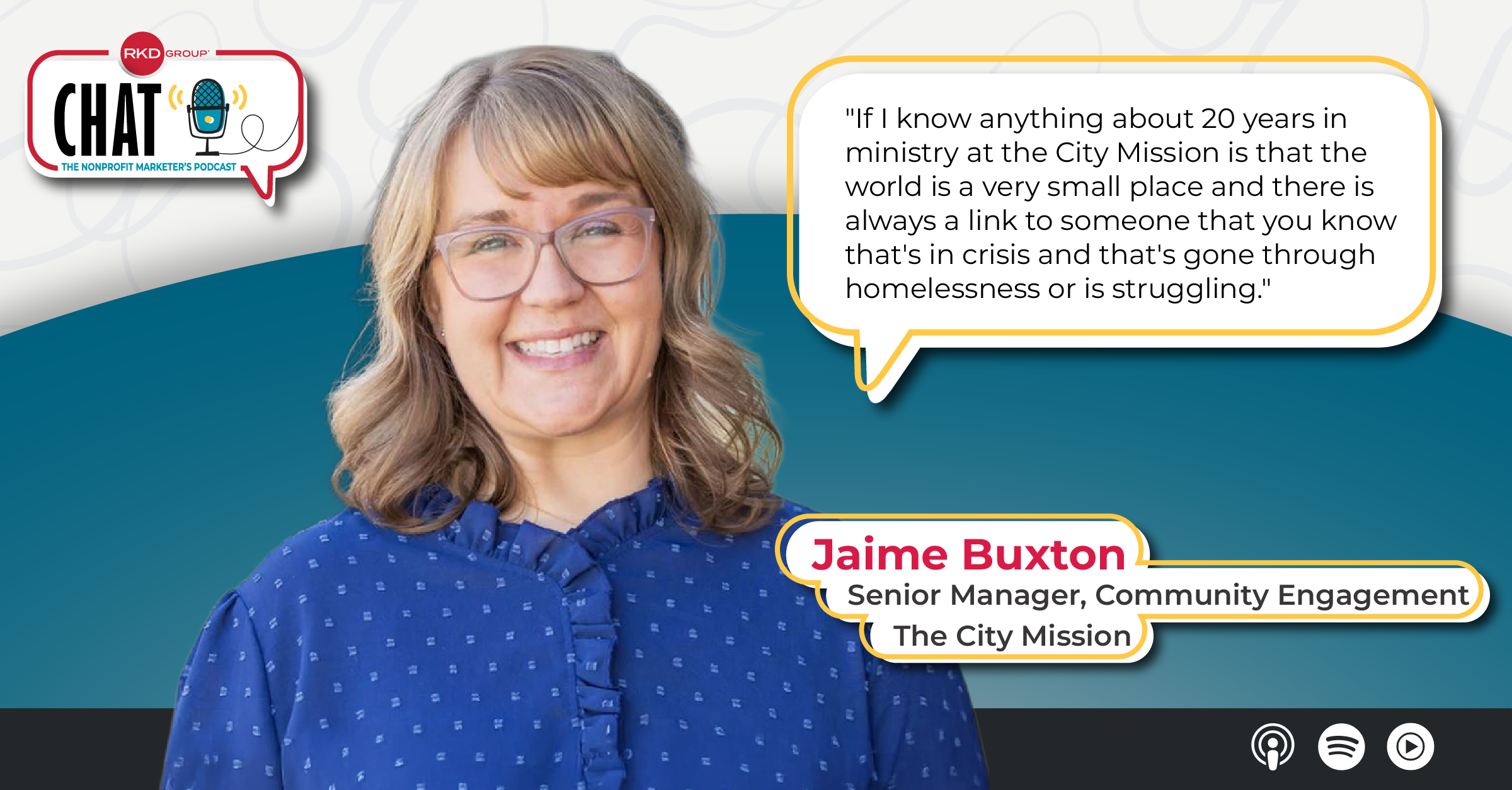
In this episode of the RKD Group: Chat podcast, host Nipa Eason sits down with Jaime Buxton of The City Mission in Cleveland, Ohio. She’s an advocate, community builder and longtime nonprofit leader whose heart for people experiencing homelessness has shaped more than two decades of service.
Jaime's path into nonprofit work wasn’t mapped out with a rigid plan. What began as a calling to help people—sparked by youth ministry and mission work in Belize—evolved into a lifelong vocation centered on dignity, compassion and community. Over the past 20 years, Jaime has grown alongside The City Mission, serving in multiple roles while helping shape programs that empower men, women and children navigating homelessness.
Today, Jaime serves in a community engagement and development role, acting as a bridge between The City Mission and churches, corporations, volunteers and donors. She advocates for the people the Mission serves by educating the community, challenging misconceptions about homelessness and helping others see the humanity behind the statistics. Her work spans partnership development, volunteer engagement, fundraising events and donor programs, including a women’s giving circle that has grown into a powerful force for connection and impact.
What stands out most about Jaime is her commitment to dignity—both in how services are delivered and in how stories are told. Whether it’s reshaping the Mission’s Christmas program to give mothers the ability to choose gifts for their children, leading Bridges Out of Poverty trainings to foster empathy and understanding or creating spaces where volunteers and residents can form healthy, respectful relationships, Jamie consistently centers the voices and experiences of those she serves.
In this conversation, Jaime reflects on her journey, the moments that affirmed her calling and what continues to motivate her through the hardest parts of nonprofit work.
She chats about:
-
How a single moment with a mother at the Mission affirmed she was exactly where she was meant to be
-
Why destigmatizing homelessness starts with education, empathy and listening
-
The importance of restoring dignity by giving people choice and ownership
-
What broken support systems really look like—and how community can help rebuild them
-
How nonprofits, churches and individuals can be part of lasting solutions beyond programs alone
Show Chapters
-
00:00 – Episode intro and Jaime's heart for the work
-
03:45 – From youth ministry and Belize to The City Mission
-
09:05 – Building community engagement during uncertainty
-
11:12 – Advocating for dignity and reshaping donor and volunteer experiences
-
13:34 – The moment that defined Jaime's purpose
-
17:28 – Bridges Out of Poverty and creating empathy that lasts
-
23:47 – Challenging misconceptions about homelessness
-
25:54 – Creating safe, welcoming environments through volunteers and partners
-
29:08 – Why belonging and support systems matter most
Meet our guest
Transcript
Jaime Buxton (00:00.492)
And I was just kind of a mess and sweating and not at my best. And I was like, I don't know how you do it. Cause her kids looked like perfect little ducks right in a row. And I said, I don't know how you do it. And I'm having a day. And she was like, I do it because I want to be like you. And gosh, I didn't expect to get emotional retelling that story. My heart really is kind of destigmatizing what homelessness looks like.
and kind of educating people on the humanity of the people that we serve.
Nipa Eason (00:40.844)
Welcome to the RKD Group Chat podcast, where we bring you behind the scenes of nonprofit life. We shed light on the compassion and purpose behind the individuals solving the world's most challenging problems. I'm your host, Nipa Eason. Today, we're chatting with Jamie Buxton from the Citi Mission in Cleveland, Ohio. She has managed thousands of volunteers and dozens of interns over the years, while also advocating for men, women, and children experiencing homelessness. Before that, she spent some time in Belize doing mission work.
Jamie has so much compassion and heart for the work she's doing and her openness and vulnerability in this conversation is beautiful and relatable. Let's chat. Hi, Jamie, it is so nice to see you and I'm so glad for this opportunity and excited to be able to talk to you about your work. And you know, like one of the things that has stood out to me in reading about your career and the things that you've been doing is
It seems like this has been a calling, a dedication that you've had your entire life. Do you want to speak to that a little bit? Just like, it sounds like you've been doing this since you were, know, pre-college, pre-like, pre-the time that people even know what they're doing.
Well, I'm glad it sounds like that on paper or, you know, on the website, but I would say God has been working in my life from an early age and I've just done each kind of step that He's asked me to do. I don't know that I ever would have dreamed of kind of the role that I'm in right now, but I'll be honest that it is my dream position.
And I feel like I'm getting to do things that I'm good at and also hard things. You know, I want to be really clear that dream positions don't mean you do only, you know, sunshine and jelly bean kinds of tasks, right? But I am given the autonomy to make decisions about things I'm passionate about, but have an equal amount of accountability with amazing people who know how to sharpen me and
Jaime Buxton (02:46.696)
and also pull me back a little bit when I need a little raining in. so, yeah, where I'm at right now, I'm incredibly grateful for the role that I'm in. Yeah.
Yeah. Do you want to speak to what kind of led you to make the decision to even move in this direction? it sounds like you did your mission in Belize and you moved on from there. What even led to that actually happening?
You mean Belize? yeah, I studied youth ministry in college, mostly because I loved my youth pastor in high school and thought, you know, this is where I want to be. I want to be making a difference in the lives of people. And quite honestly, a non-Christian friend, her mom at a sleepover was like, maybe you should be a youth pastor. And I was like, you think? And so I went and studied.
Yeah.
Jaime Buxton (03:45.114)
in, studied youth ministry and missions in college. But I remember really, really vividly as I started ending that college career thinking, this was great, but I really am not sure that I want to work in a church, which, you know, I'm an only child. My parents did not love that realization that, you know, after all that money spent and all that time spent. it wasn't in vain. I loved that part of my education. So,
I actually had a January term back in the day where I spent a month in Belize and fell in love with the country and the people and really felt like, I'm not really sure what I want to do next in life, but I feel really called to help people. And actually at that time, if I'm being honest, Nipa, I think I was really struggling between there and some inner city work in Chicago. And I had all but kind of signed a contract with
an organization in Chicago, and I remember feeling really conflicted and thinking, why isn't God just making this so obvious where I'm supposed to go next? And I talked with some really awesome believers who kind of poured into me, and I remember really speaking to a gentleman who said, you know, sometimes God just gives us a choice, Jamie, like I don't think it has to be, you know, this writing on the wall that defines this way is the only way you can go.
And so, you know, I made a choice and the choice was Belize and I loved my time there. Ironically, once I got there and started doing things, I loved what I was doing. But I kept knowing there was something more. When I left there, I really thought that that was going to be nursing school because I had kind of fallen in love with like helping people physically.
Yeah, it's the same kind of like psychological pressure.
Jaime Buxton (05:39.19)
Yeah. So I really thought, okay, I'm going to go home and I'm going to go start nursing school, but I needed a job to kind of sustain myself, of course. And so as I was leaving Belize, it had become just a period of some social unrest while I was there and it was becoming unsafe. And I think I already said I was an only child. So my parents were like, you're coming home.
Yeah, that's a scary thing to have your child, your daughter out there.
Yeah, it was more scary for them for sure, but I get it now, now that I'm a mom. So I went to an internet cafe to email all of my friends and AOL instant message my friends.
this that takes me back.
I know, right? Yeah. Prepare the parties. I'm coming home. so, waiting for me in my inbox was an email from a friend from college who said, hey, I work at this amazing place called Laura's Home. It's part of the city mission. And I don't know why. I just think you're the person who's going to fill my job. She really had no business saying that, right? Because, you know, she was leaving and moving across the country. And I was like, okay. And so,
Jaime Buxton (06:48.79)
I came home, kind of settled in. think I interviewed that Wednesday. I think I flew home on a Saturday. I interviewed on the Wednesday and I've been working at the City Mission ever since. I've spent a lot more formative years, early 20s, and I'm not in my 20s anymore. I've spent the last 20 years working at the City Mission in kind of all different positions, but just so grateful for.
the opportunity to serve in a ministry that I'm passionate about, but also that they let me grow up and kind of figure out what I was doing too. You know, I know that wasn't the purpose in hiring me, but there's been so much grace and kind of as I've shown my strengths, different opportunities became available. And so that's been really, really, really special to me.
I know that some of them will watch this, but I say it all the time behind my CEOs and my bosses back that I'd probably work for free just because I was given so much opportunity to grow up and kind of find who I was made to be in the context of this ministry. you know, in that time I got engaged and married, started having my own family and Nipa, all four of my boys grew up coming to work with me.
at Laura's That's beautiful. Yeah. So there were days that I was holding my own baby, talking to kids about Jesus while ministering to their moms. And I just was like, maybe not in that moment, but now that I'm looking back on it, I'm like, I couldn't have even known to ask for that kind of gift, that I could be a full-time parent, but also working in a ministry that I care deeply about. It just doesn't get any better than that.
That's amazing. And it's such a hard thing to find that kind of role, that kind of place, that kind of culture that you can grow into like that for so long. That's beautiful. I wanted to ask you what currently is kind of the typical day that you're having at the City Mission? Because it feels like you moved into a lot of different roles. And now it seems like you're more in, I would almost...
Nipa Eason (09:05.674)
it seems a little bit more like a community building role, right? And that's such a big part of so many of our nonprofits that they want to be able to build these communities. And how would you describe your typical day in that kind of context? Yeah.
There is no typical day. That's the first way I describe it. I would have thought even five years ago that that would drive me crazy. I really like having a checklist and being able to mark things off of a list and say, is what I've accomplished in timeframes. And that is so not the way my role generally works at this point. But...
Yeah, I was asked to step into community engagement in 2020, which was a very unique time to be asked to build a new role for the mission because no one wanted to have community with me in 2020. And really not in 2021 and some of 2022 either really. I feel like it took a long time to really settle in and figure out what really were the missions expectations of this role and then what are realistic expectations.
while it still takes shape a lot, I am the liaison to our church and corporate partners. Now I've got a partner in crime now who helps with the corporations because this role has gotten bigger, which is what it's supposed to do, right? But I couldn't have imagined that in 2021, no one wanted to talk to me, let alone meet with me or invite me to their place of work, right? So it's my privilege to get to be an advocate for the men, women and children that we serve.
especially into the church context and then going into corporations, doing things like lunch and learns and talking about what we do. My heart really is kind of destigmatizing what homelessness looks like and kind of educating people on the humanity of the people that we serve. Because I think it can feel like
Jaime Buxton (11:12.868)
well, that will never touch me, and so I really don't need to worry about that. And if I know anything about 20 years in ministry at the City Mission is that the world is a very small place and there is always a link to someone that you know that's in crisis and that's gone through homelessness or is struggling. So yeah, that's kind of the gist of my role. Now, I am part of the development team, which means
I also lead our efforts for our big fundraising events. So we have a gala and a run and I get to lead those efforts. And then we also have a giving circle for women. That was something that was added to my role just in this last year and has really added so much joy. So we have about 80 women, 75 women, I don't wanna embellish, about 75 women.
who give a thousand plus dollars to the mission annually, but we engage them in their own kind of created opportunities for volunteerism and getting kind of bird's eye view of what we're doing, some special activities. In fact, I'll be with some of our ladies tonight as we're wrapping Christmas presents, but they get to choose then how their money is spent. So, you that's about $80,000 now. And so that's significant. So that's really special.
So that's become really a great source of joy in this role as well as getting to interact. really I think what it is for me is taking those women even deeper into what we're doing and allowing them to understand us on a level that not just a normal donor might not choose to go kind of this deep.
Yeah, right. that's amazing. I wanted to go back to what you mentioned a little bit about destigmatizing homelessness and, you know, kind of drawing that attention to the fact that it may not touch us directly, but we may have a direct link to something that's related to it. I mean, the work you do, it can be really hard every day seeing this kind of just
Nipa Eason (13:34.456)
how the world is kind of moving in this direction right now. What motivates you right now? How do you kind of balance that? And what motivates you to keep coming to work every day and doing the hard things that you do?
Goodness, that's a really amazing question. I think so many things motivate me. There's several stories, several women, and they're not even that recent of stories, but I will never forget, and this really was one of those moments in life and especially in my career that really defined the kind of woman, kind of person.
I want to be. so as I said, I was able to take my kids to work with me. I remember rushing into work one day to clock in. was still, I was working in childcare, so it was in the first 10 years. And I had at least two kids in tow in bags and lunches. And I just remember being flustered and late and trying to like fight with the time clock. And down the elevator opened behind me and a mom whose kids were in my classroom.
kind of came out and they just kind of were in ducks in a row. I think she had about, I think she had four or five children and she came out and I was just kind of a mess and sweating and not at my best. And I was like, I don't know how you do it. Cause her kids looked like perfect little ducks, right in a row. And I said, I don't know how you do it. And I'm having a day and she was like, I do it because I want to be like you. And gosh, I don't, we didn't expect to get emotional retelling.
No, that's so, I'm getting emotional. That's such a nice thing to hear, right? In a moment like that.
Jaime Buxton (15:09.902)
But it was such a moment and I was like, I'm exactly where I'm supposed to be. Even when I'm a sweaty mess and I'm doing all the things wrong, it just really opened my eyes to you never know who's watching you. And while my role is no longer direct, resonant facing, I don't have every day I'm not rubbing shoulders with the people that we're serving. That's not where I'm at anymore. And some days I really, really miss that.
But that still inspires me is you never know who you're watching and who's learning from you. And so I want to advocate and be a voice for the men, the women, and the children that we serve to a community that may not know that they need to understand it and to create empathy in spaces people are probably unaware of is really what drives me every day. When I see a light click on for someone or
I have the opportunity to, I lead kind of our efforts in teaching bridges out of poverty and our, at the mission, but we open that up. And when I have that opportunity to teach that material and I see someone like the lights come on or they have that aha moment or even how they say, I'm going to do this differently in whatever capacity, that is what motivates me. I want people to understand that crisis.
does not discriminate. And while homelessness may feel really far from, you know, even where I'm at today, crisis and hurt and pain can happen to anyone. And that is really all that we're doing at The Mission is we are serving people who are going through what I described to kids as a really big problem that we can't solve on our own, right? Like, talk about that. Yeah.
And that is what motivates me. That's what drives me to drag my kids still along with me when I can to give them just this continued understanding of not everyone has the same resources, but we're all created in the same image of the same God. And that's really important to me.
Nipa Eason (17:28.319)
That's amazing. Thank you for sharing all of that and that story too. I really appreciate that. You've mentioned so many programs and things that have carried a lot of meaning for you. What would you say is one of the most meaningful programs that you've worked with at the mission?
goodness.
Well, I think I just alluded to it and I'll probably stick in that same area is Bridges Out of Poverty has been something that the mission, you know, we've read the book, we've done small groups, it's been kind of a part of our culture for a long time. And again, in 2020, for whatever reason, before COVID hit, we had the opportunity, three of us, to get trained in Bridges Out of Poverty and
While those people are no longer at the mission, it's been something that we have stayed, you know, this is important for our staff to know, for our volunteers to interact with. I love the teaching and kind of the mantras of Bridges Out of Poverty. I add a lot of Jesus to it and probably a little too much Jamie to it. But that is one of my favorite things is when you have, you know, two plus hours with individuals who
are seeking to better understand and to kind of go through that material. And we only do the lens of the individual lens where it's how is it that I interact with people from different socioeconomic classes than myself? And how does that make us feel? And that to me is probably still the most meaningful thing, mostly because we have the opportunity to see, like I said, like it clicks for people.
Jaime Buxton (19:17.422)
But as far as things we do internally, we're recording this in December. So I will be honest, this week is nuts for me because I am still the mastermind behind Christmas and have been for probably 18 of the years that I've worked at the mission. so, yeah, one of the most powerful things that we do and we learned it through reading When Helping Hurts from Chalmers, right, is
And we haven't always done Christmas this way. And I'll be honest, when our CEO asked me to change it several years ago, she said, know, Jamie, I know you are doing a lot of hard work and you're organizing gifts and you're making sure kids are getting, you know, a learning toy and a craft toy and fun toys. She's like, but we want to give, you know, the dignity back to the moms. And so, so for years we've been doing that. Our moms last week, as we prepare to go into our Christmas fair.
each pay 25 cents a ticket and they're able to buy up to five tickets for each of their kiddos. So actually today and yesterday our families were shopping and our moms are shopping. And then like I said, tonight I will be there with people to help wrap all those gifts and then they're put away in storage until Christmas Eve when other volunteers will come and distribute those gifts outside of doors like Santa came. But I remember saying, I don't want to do it that way.
I love getting to organize the Christmas gifts and I love getting to meet all the donors and I love and I had to stop myself. It really was one of those things where I was like, yeah, I did just say I and what I do a whole lot right here. And that was really convicting. And it is amazing to watch the moms and every year when we describe, okay, we're going to have you pay these 25 cents. I remember thinking the first time I'm like, they're going to throw stuff at us. They're going to be so angry. And it just was the total opposite.
It was like, you get it, you see me. And I get it now too. You know, I'm a mom and it's like, I'm the mom I want to provide. And not only just provide, just like the charity that you give me, but I want to choose that special gift that I know my kiddo wants. Yeah. And so that for me and then bringing other people into that and teaching, I have a whole new staff in our volunteer department. Right.
Jaime Buxton (21:43.39)
right now and this was their first Christmas working with us. I mean, it's been a whole first year of first for them, but bringing people into that and helping them see and how we can care and we can add dignity and more respect for the individuals that we serve. There's nothing more exciting to me than that. And even, and I do look forward to the critique and how we can make this better each year and other things too.
I'm never opposed to conversations, even though it makes for harder work to say, how can we be more empathetic in how we're sharing this story? How can we put ourselves in check and take us as the saviors out of it and give dignity to God, but also to the programs and the processes that our residents are going to go through and work through themselves, not what we're doing for them.
Yeah, the Christmas program you're talking about, it sounds magical. I'm sure those moms appreciate it so much being able to actually choose, like you said, choose the toys and choose what they're getting to do and have an investment in it. They have some ownership of that, which is incredible. You talked about destigmatizing and talking through common misconceptions about homelessness.
What do think is the most common misconception that you have to combat when you talk to people that aren't fully connecting with it? When you see that light switch turn on.
Yeah, I think so many things. People think that individuals experiencing homelessness are lazy or that they're all addicted to something or it's all domestic violence or it... I think this one, again, I mean, we've already talked about that this is Christmastime. A big one for me is that, those poor homeless people, have no one that cares about them. Now, I will be honest that the...
Jaime Buxton (23:47.99)
The question I get asked the most in my career is, what is the one thread that you see kind of in every story? And that's hard because the stories are so expansive and so different and what people experience are unfathomable most to me. But broken support systems, right? That is the one inner, you know,
thing they all kind of have in common is broken support systems. But when I say that, I don't mean that they don't have family or friends or people that love them. They may not be the healthiest of relationships. Or when you're talking about generational poverty and you're talking about, you you have people who love you, they just can't help you financially, right? Like, so, you know, everyone thinks, I'm going to go on Christmas day and just be there for those poor homeless people.
Well, a lot of our residents are gonna have passes and they're gonna go be with people that they care about. Now again, they may not always be, this is a time we really pray to make sure that our families don't slink back into old habits or hard things happen when they're on these passes. I think that they do have people who love them and they desire to have an intact support system, people who can be role models and
Be accountability partners for them. That's what we really need more of. So when I'm in the churches talking about what we're doing, I want to equip churches not just to have good programs. We want to equip churches to be prepared to do just that, invite these men and these women and these children into their small groups, into their homes, into their normal, regular lives.
and be a part of a support system that we're starting at the mission. But we hope that they can replicate and gain more of those people who kind of have their back as they leave us.
Nipa Eason (25:54.51)
Yeah, and having that kind of safe but welcoming environment is so, so important. How do you all kind of work to create that? Because that's, I feel like missions in general need to have that kind of safety, that kind of welcoming warmth for people to feel comfortable coming to you for help.
Yeah, so think we do that in lots of different ways. You I talked about, you know, trying to create kind of streams for when Our Ladies are leaving in different churches that they might go to. It's not even for me about the church as much as just kind of, hopefully we're impacting the culture of people being more understanding and more empathetic to others. But of course we have, you know, a volunteer onboarding process that makes sure
We're inviting people in who are going to be a positive influence for our residents. Now that doesn't mean they all have to be Christians and we all think exactly the same, but we do let people know who we are and that we want you to be understanding of that and don't proselytize against or dumb down or…
say anything negative possibly about what we're saying. We want their time there to be encouraging, but in the same way, we don't have just robots. We want people who are willing to have actual relationships, positive, healthy relationships with our residents as they're coming in to volunteer. I get people all the time, well, I'm a man. Am I allowed to go to Laura's home where you serve women?
Absolutely, if you're going to treat women with respect and kindness, yes, we want you there. Absolutely. know, married couples, can we do this? Yes, it's so good for our residents to see healthy relationships. And so, yeah, I think that's a big part of what, I don't think it, I know it, that is a big part of who we are and making sure that we're equipping volunteers to kind of replicate the work that we know that as staff.
Jaime Buxton (28:10.05)
There's just not enough of us. There could never be enough of us or enough money to do all the things we want to do. So we lean heavily on those volunteers. But I recently heard about an awesome collaboration that we have. The name of the group escapes me, but they actually are just received grant money where they come in and they are discipling our ladies, but also teaching our ladies how to be, how to disciple their children and how to be a Christian mom.
And then they're actually walking alongside our ladies as they exit, as they graduate from our program, helping them find churches and get them into small groups and get them into programs that are going to be close to where they're living. And I was like, this is exactly what we need, you know, because there's only so much we can do. So partners like that, like that is incredibly valuable. And so, yeah, we just hope that
Yeah, the support system.
Jaime Buxton (29:08.522)
When we have conversations that are real like this one, that people will hear that and say, well, I can be part of that. Like, this is something I can do. You know, when I heard about this woman, I said, I recently went through a personal church transition. Where were you? Like, could they just help the ladies understand the different churches and what they believe and how they might fit in? And I was like, this is awesome. Everybody should have this resource.
Yeah, just finding that place of belonging. It's so important and it can be so hard and that's an amazing thing that they're doing. Thank you so much, Jamie, for talking to me today. And I think, like, yeah, you just gave me so much to think about and just, you're so inspiring and the work you're doing is, it's magical and amazing. I wish you the best of luck with the Christmas.
market and wrapping gifts tonight. And I think that's going to be a beautiful Christmas. Just a thousand gifts. That's not too bad. But you have so many women coming to help you, which is, you again, that support system is key. And I think that's a beautiful thing.
tips.
Jaime Buxton (30:13.474)
Yeah. Thank you so much for having me. It's been a real pleasure.
That was such an amazing conversation. And here are three takeaways I got from our chat with Jamie that I would take back to my nonprofit or to even my own personal relationships and in my own life. One, sometimes opportunities cross your path and it's not always clear which direction to pursue. You have a choice to make and there's no right or wrong answer and you just kind of have to do what feels right in that moment. Two,
Broken support systems are often a commonality when we're talking about homelessness. Creating a safe space, providing compassion, empathy, and support to those experiencing homelessness is so, important. And three, we might all be sweaty messes sometimes, but there are always people around us who will make us feel seen and understood. And, you know, we never know who's watching and learning from us, even on those really hard days. So.
Do you want to chat with us? Email us at connect at rkdgroup.com. I hope I hear back from you and either way, I'll chat with you next month.




Leave a comment: